Problem Statement#
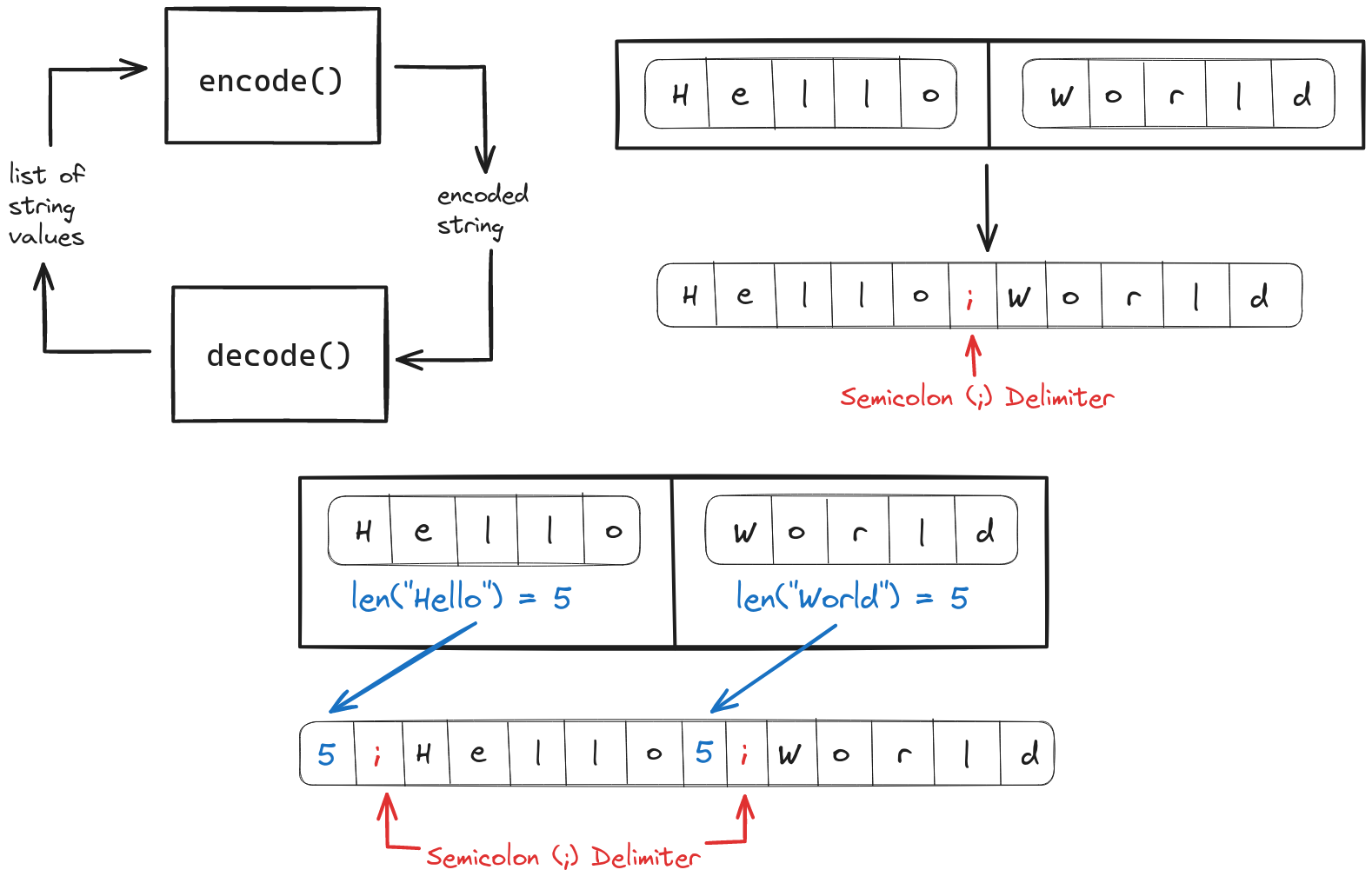
We have to implement an encode function that takes a list of string values as input and returns a single encoded string that could be transmitted over a network. On the other side of the network, the decode function will take the encoded string as input and return the original list of string values as output.

A delimiter could be used to differentiate between words. For example, ["Hello", "World"] could be encoded with comma delimiter (,) to "Hello,World".
Brute Force Solution#
In the brute-force approach to solving this problem, we can execute a loop over the input list appending each string with some special character as a delimiter.

If the special character is a part of the string itself (for example "Hello,") then we can add an escape character before it, such that it is easier to differentiate from the delimiter during decoding.
Psuedo-code for the Brute Force Solution#
 1
 2
 3
 4
 5
 6
 7
 8
 9
10
11
12
13
14
15
16
17
18
19
20
21
22
23
24
25
26
27
28
29
30
31
32
33
34
35
36
37
38
39
40
41
42
43
|
func encode(array)
  delimiter = ","
  encodedString = ""

  loop index on array
    string = array[index]
    new_string = ""

    loop index2 on string

      if string[index2] is delimiter or "\"
        new_string.append("\")

      new_string.append(string[index2])

    if encodedString is not empty
      encodedString.append(delimiter)

    encodedString.append(new_string)

  return encodedString

func decode(encodedString)
  delimiter=","
  decodedList = []
  string = ""

  loop index on encodedString

    if encodedString[index] is "\"
      string.append(encodedString[index+1])
      index++

    else if encodedString[index] is delimiter
      decodedList.append(string)
      string = ""

    else
      string.append(encodedString[index])

  decodedList.append(string)

  return decodedList
|
Time Complexity Analysis#
Best Case Scenario#
The best-case input for the brute force solution would be a string full of delimiters since the decoding process will finish earlier (the index is incremented by 2 while encountering the escape character \).
The time complexity of encoding and decoding in the best-case scenario would be $O(k \times n)$ where $k$ is the average size of the string and $n$ is the size of the input array.
Worst Case Scenario#
For the worst-case time complexity of the brute-force solution, the input should not contain the delimiter or escape characters. The time complexity of encoding and decoding would still be $O(k \times n)$.
Space Complexity Analysis#
The additional space required to store the encodedString and decodedList will be $O(kn)$.
Code for the Brute Force Solution#
 1
 2
 3
 4
 5
 6
 7
 8
 9
10
11
12
13
14
15
16
17
18
19
20
21
22
23
24
25
26
27
28
29
30
31
32
33
34
35
36
37
38
39
40
41
42
43
44
45
46
47
48
49
50
51
52
53
54
55
56
57
58
59
60
61
62
63
64
65
66
67
68
69
70
71
72
73
74
75
76
77
78
79
80
81
82
83
84
85
86
87
88
89
90
91
92
93
94
95
96
97
98
99
|
package main

import "fmt"

func encode(inputArray []string)(string){
    delimiter := ","
    encodedString := ""

    for index:=0;index<len(inputArray);index++{
        str := string(inputArray[index])
        updatedStr := ""

        for index2:=0;index2<len(str);index2++{
            char := string(str[index2])

            // If the delimiter or "\" is within the string
            // add an extra escape character (\))
            if char==delimiter || char=="\\"{
                updatedStr += "\\"
            }

            updatedStr += char
        }

        if len(encodedString)!=0{
            encodedString += delimiter
        }
        encodedString += updatedStr
    }

    return encodedString
}

func decode(encodedString string)([]string){
    delimiter := ","
    decodedList := []string{}
    str := ""

    for index:=0;index<len(encodedString);index++{
        char := string(encodedString[index])
        if char == "\\"{

            // If we encounter an escape character in the encoded string
            // Add the next character to the string
            // and increment the index by 1
            str += string(encodedString[index+1])
            index += 1

        } else if char==delimiter{

            // If we encounter the delimiter
            // Add the current string to decodedList
            // and reset its values
            decodedList = append(decodedList, str)
            str = ""

        } else {

            // Add the string to decodedList
            str += char

        }
    }

    decodedList = append(decodedList, str)

    return decodedList
}

func main(){
    inputArray := []string{"Hello", "World"}
    encodedString := encode(inputArray)
    fmt.Println("Input Array", inputArray)
    fmt.Println("Encoded String:", encodedString)
    fmt.Println("Decoded String:", decode(encodedString))

    inputArray = []string{"Hel,lo", "World"}
    encodedString = encode(inputArray)
    fmt.Println("Input Array", inputArray)
    fmt.Println("Encoded String:", encodedString)
    fmt.Println("Decoded String:", decode(encodedString))

    inputArray = []string{"Hel\\,\\lo", "World"}
    encodedString = encode(inputArray)
    fmt.Println("Input Array", inputArray)
    fmt.Println("Encoded String:", encodedString)
    fmt.Println("Decoded String:", decode(encodedString))
}

// Output
// Input Array [Hello World]
// Encoded String: Hello,World
// Decoded String: [Hello World]
// Input Array [Hel,lo World]
// Encoded String: Hel\,lo,World
// Decoded String: [Hel,lo World]
// Input Array [Hel\,\lo World]
// Encoded String: Hel\\\,\\lo,World
// Decoded String: [Hel\,\lo World]
|
Optimized Solution#
We can improve the time complexity of the brute-force solution if we can somehow omit the loop over each string.
If the length of the string could be used as a delimiter then we can avoid iteration over individual strings because the length function len(string) has $O(1)$ time complexity. But, this presents two more challenges
- if the length of a string is greater than 9 (double digits)
- if the string contains numbers, they could be confused with the length of the strings

To improve on this we can use a special character with the length of the string as delimiters, for example, ["Hello", "World"] could be encoded to 5;Hello5;World.
Psuedo code for the Optimized Solution#
 1
 2
 3
 4
 5
 6
 7
 8
 9
10
11
12
13
14
15
16
17
18
19
20
21
22
23
24
25
26
27
28
|
func encode(array)
  delimiter = ","
  encodedString = ""
  loop each element in array
    encodedString.append(len(element), delimiter, element)

  return encodedString

func decode(encodedString)
  delimiter = ","
  decodedList = []

  index = 0
  while index<len(encodedString)
    index2 = index
    while encodedString[index2] is not delimiter
      index2++

    stringLen = toInt(encodedString[index:index2])

    string_start = index2+1
    string_end = index2+stringLen+1
    string = encodedString[string_start:string_end]
    decodedList.append(string)

    index += string_end

  return decodedList
|
Time Complexity Analysis#
Best Case Scenario#
The best-case input for the optimized solution will contain strings with length < 9.
The time complexity of the encoding loop will be $O(n)$ because it will iterate over all the elements in the array.
For the decoding loop, the time complexity appears to be $O(kn)$ but we are incrementing the index by the length of string value ($k$) on every iteration. Thus, the time complexity of decoding is also $O({kn \over k}) = O(n)$.
Worst Case Scenario#
The worst-case time complexity of encoding is the same as the best-case i.e. $O(n)$.
The time complexity of the decoding function will depend on the number of digits (in the length of the largest string). For example: If the length of the largest individual string is 199990 then the time complexity of decoding the string will be $O(6 \times n)$ (because 199990 has 6 digits).
Space Complexity Analysis#
The space complexity of the optimized solution will be the same as the brute force solution ($O(kn)$) as no additional data structures are used.
Code for the Optimized Solution#
 1
 2
 3
 4
 5
 6
 7
 8
 9
10
11
12
13
14
15
16
17
18
19
20
21
22
23
24
25
26
27
28
29
30
31
32
33
34
35
36
37
38
39
40
41
42
43
44
45
46
47
48
49
50
51
52
53
54
55
56
57
58
59
60
61
62
63
64
65
66
67
68
69
70
71
72
73
74
75
76
77
78
79
80
|
package main

import (
    "fmt"
    "strconv"
)

func encode(inputArray []string)(string){
    encodedString := ""
    for index:=0;index<len(inputArray);index++{

        // For each string append
        // the string length
        encodedString += strconv.Itoa(len(inputArray[index]))

        // "#" delimiter
        encodedString += "#"

        // the string itself
        encodedString += inputArray[index]
    }
    return encodedString
}

func decode(encodedString string)([]string){
    decodedList := []string{}
    index := 0
    for ;index<len(encodedString);{
        index2:=index
        for ;string(encodedString[index2])!="#";{
            // Exit loop upon encountering the delimiter
            index2+=1
        }

        // The length of individual string would be parsed
        lenString, _ := strconv.Atoi(encodedString[index:index2])

        // Extract the string from the encodedString
        str := string(encodedString[index2+1:index2+lenString+1])

        // Append the string to decodedList
        decodedList = append(decodedList, str)

        // Increment index, moving it to the next string length
        index += index2+lenString+1
    }

    return decodedList
}

func main(){
    inputArray := []string{"Hello", "World"}
    encodedString := encode(inputArray)
    fmt.Println("Input Array", inputArray)
    fmt.Println("Encoded String:", encodedString)
    fmt.Println("Decoded String:", decode(encodedString))

    inputArray = []string{"Hel,lo", "World"}
    encodedString = encode(inputArray)
    fmt.Println("Input Array", inputArray)
    fmt.Println("Encoded String:", encodedString)
    fmt.Println("Decoded String:", decode(encodedString))

    inputArray = []string{"Hel\\,\\lo", "World"}
    encodedString = encode(inputArray)
    fmt.Println("Input Array", inputArray)
    fmt.Println("Encoded String:", encodedString)
    fmt.Println("Decoded String:", decode(encodedString))
}

// Output
// Input Array [Hello World]
// Encoded String: 5#Hello5#World
// Decoded String: [Hello World]
// Input Array [Hel,lo World]
// Encoded String: 6#Hel,lo5#World
// Decoded String: [Hel,lo World]
// Input Array [Hel\,\lo World]
// Encoded String: 8#Hel\,\lo5#World
// Decoded String: [Hel\,\lo World]
|
Thank you for taking the time to read this blog post! Have questions, feedback or want to discuss this topic? Feel free to reach out at [email protected].
If you found this content valuable and would like to stay updated with my latest posts, consider subscribing to my RSS Feed.
Resources#
659 · Encode and Decode Strings
Encode and Decode Strings - Leetcode 271 - Python